
For someone in the middle of fertility treatment, stress can become part of the routine.
There are injections to administer, appointments to make, blood tests to schedule, and results to wait for. Then there is the strange experience of having your body become the subject of constant monitoring, which can leave people feeling disconnected from it.
Now, some fertility programs are turning to an unexpected source of support: animals.
The Science Behind Animal-Assisted Therapy
Animal-assisted therapy has been used alongside psychotherapy for decades, with dogs and horses among the animals most commonly involved. Research has explored its use for people experiencing anxiety, depression, PTSD, and other mental health challenges, and several reviews have found potential benefits for symptoms of anxiety and depression (1, 2, 3, 4). Studies have also examined animal-assisted interventions in settings ranging from hospitals and universities to long-term care facilities.
The animals and activities vary. Some programs involve therapy dogs, others work with horses. What they share is a structured interaction between a person and an animal, typically guided by a trained professional. The idea is simple: sometimes, regulating your nervous system doesn’t start with talking.
How Horses Add Something Talk Therapy Doesn’t
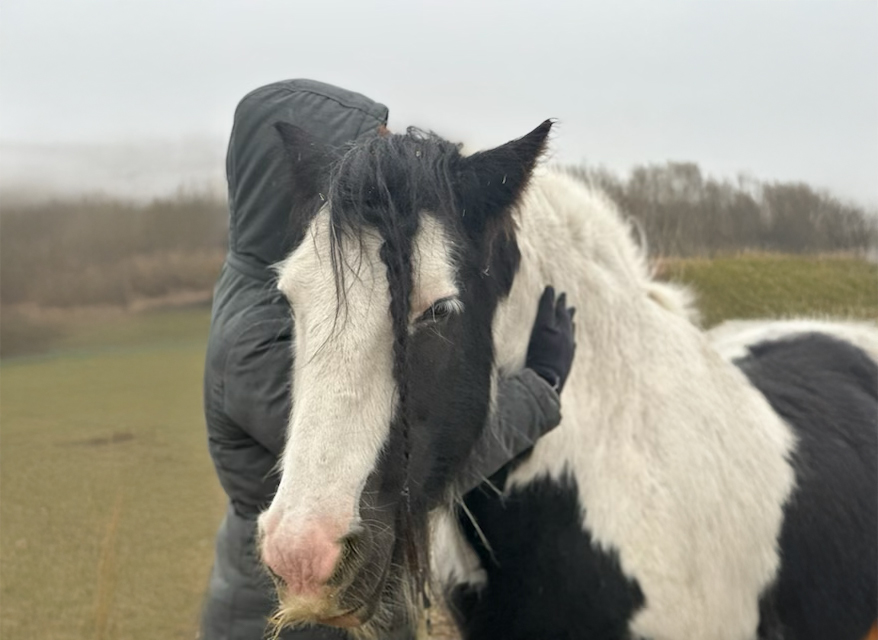
Horses are particularly interesting in this context. As prey animals, they’re highly responsive to movement, posture, and other aspects of human behavior. During an equine-assisted session, a therapist can observe how a horse responds to a person, and use that interaction as another way of exploring emotions, boundaries, and regulation.
A client may notice, for example, that a horse moves away when they become tense, or settles when they slow their breathing. That interaction creates an immediate, tangible way to notice what’s happening in the body, something conversation alone doesn’t always surface.
There’s growing research on equine-assisted approaches for anxiety, depression, and emotion regulation specifically (1, 6). There’s an important caveat, though: research specifically examining equine therapy among fertility patients is still lacking. The evidence doesn’t yet show that equine therapy improves fertility outcomes, or that it works specifically for the psychological challenges of fertility treatment. What exists so far is a broader evidence base around animal-assisted and equine-assisted interventions, combined with a plausible rationale for exploring them in fertility care.
Why This Might Matter for Fertility Patients
People undergoing fertility treatment can experience significant psychological distress. Research has found higher rates of anxiety and depression among people experiencing infertility compared with the general population (7).
Fertility treatment adds its own layer of emotional strain. There’s uncertainty built into nearly every stage of a cycle, along with medications and procedures, repeated appointments, and the anticipation that comes with every test result. For some people, the process can make their bodies feel less like something they inhabit and more like something being measured and managed.
That’s one reason psychological support has increasingly become part of fertility care. And it’s part of why the body-based approach horses offer, working with the body and the environment rather than relying on conversation alone, has started showing up in fertility programs specifically.
One Program Putting Horses at the Centre of Fertility Support
In Sherwood Park, Alberta, psychiatrist Dr. Shreyasi Brodhecker and reproductive psychologist Caroline Andersen are putting that idea into practice.
Shreyasi and her partner Frank own Mindful Mare Wellness, which has been offering equine-facilitated therapy programs since 2021. They have received training from Equine ConnectionTM and Shreyasi is an equine practitioner certified by the Academy of Horse Medicine. Shreyasi and Frank both work in mental health, and offer group and 1:1 equine-facilitated therapy sessions for individuals with chronic depression, anxiety and trauma. Together with their herd of thirty horses at Spirit Farm Gypsy Cobs, they have helped countless individuals regain a quality of life and feel moments of joy again.
Caroline and Shreyasi crossed paths in early 2025, and together created Sacred Ambrosia- an equine-facilitated therapy group for women on an IVF/IUI path. This is a five-week program for women struggling with infertility, and wanting a place to connect to others who can relate, explore the rollercoaster of emotions on their path and also spend time in nature and connecting to the horses.
Caroline and Shreyasi offer journaling prompts, explore emotions and stories, and somatic practices to help women connect to their hearts and wombs. This is complemented by the equine component, which also relates to and deepens somatic presencing, mindfulness, and trusting one’s intuition and insight in the field with horses.
A typical session in the Sacred Ambrosia program doesn’t involve riding at all. Instead, it takes place entirely on the ground, and might include grooming a horse, standing near the herd during a grounding exercise, or simply observing how a horse responds to a person’s presence. The interaction itself is the point. Women have said over and over, that being with the horses has brought them a joy and peace they’d lost touch with, and they form lasting connections with specific horses they’ve bonded to in the herd. One touching story is that a lady who has since successfully conceived, printed photographs of her favorite horse at Spirit Farm and placed them across her home as a positive inspiration on her journey.
The approach of horse-human connection on the ground carries through to how the program treats consent. It’s trauma-informed, and the horses are never forced to participate. If a horse doesn’t want to engage, that becomes part of the process rather than something to work around, and in that sense, consent runs in both directions: the person’s and the animal’s.
Although research is pending, Caroline and Shreyasi notice that there is a degree of safety and unconditional acceptance offered by horses that is hugely beneficial for women who are struggling with the grief and uncertainty of infertility. Body safety and autonomy, feeling safe in their bodies, and experiencing tangible pleasurable experiences through connection with each other and the horses, are all ways that the ladies appear to benefit from the Sacred Ambrosia program.
The program continues to expand and Caroline, Shreyasi and the team at Mindful Mare Wellness are so excited to offer this powerful and exciting new complementary healing modality for those struggling with infertility!
What to Look for in an Animal-Assisted Program
Animal-assisted therapy is a broad and evolving field, and not every program offering time with animals is providing clinical therapy. Training and credentials can also vary considerably between practitioners.
For someone considering this type of support during fertility treatment, the qualifications of the person leading the session matter. Ideally, look for a licensed mental health professional who also has appropriate training in animal-assisted or equine-assisted work. Experience working with fertility patients is another important consideration, since infertility and fertility treatment involve experiences that are highly specific to reproductive health.
Animal-assisted therapy should be viewed as a complement to medical and psychological care, not a replacement for it. There’s still much to learn about how these approaches fit into fertility care, but programs like Mindful Mare Wellness are offering patients another way to approach an experience that affects far more than the body.
Connecting with Caroline and Shreyasi
If you’d like to learn more about Sacred Ambrosia, or to connect with Caroline or Shreyasi, you can reach them below:
Caroline: https://carolineandersen.ca/; Instagram: @carolineandersenpsych
Shreyasi: https://shreyasibrodhecker.com/; Instagram: @shreyasi_brodhecker
Caroline and Shreyasi are currently working on creating a Workbook for Infertility, intended to be a journal and resource for women on the infertility journey and/or receiving fertility treatments. They hope to release the Workbook during Canadian Fertility Awareness Week in April 2027.
Sources
- Selby, A., & Smith-Osborne, A. (2017). A systematic review of effectiveness of complementary and adjunct therapies and interventions involving equines. Health Psychology, 36(4), 418–432.
- Eke, E., & Mitchell, C.R. (2019). Animal Assisted Therapy (AAT) in Depression and Anxiety: A Systematic Review. ISPOR Europe.
- Animal-Assisted Therapy for Reducing Anxiety in Vulnerable Clinical Populations: A Systematic Review (2013–2023 studies), PMC, PMC12840666.
- Compilation of animal-assisted therapy studies: A narrative review of clinical evidence. ScienceDirect, 2025.
- Souilm, N. (2023). Equine-assisted therapy effectiveness in improving emotion regulation, self-efficacy, and perceived self-esteem of patients suffering from substance use disorders. BMC Complementary Medicine and Therapies, PMC10576391.
- Bahonar, Z., et al. (2023). Effectiveness of Counseling for Infertile Couples on Women’s Emotional Disturbance: A Randomized Clinical Trial. PMC, PMC10183932.