
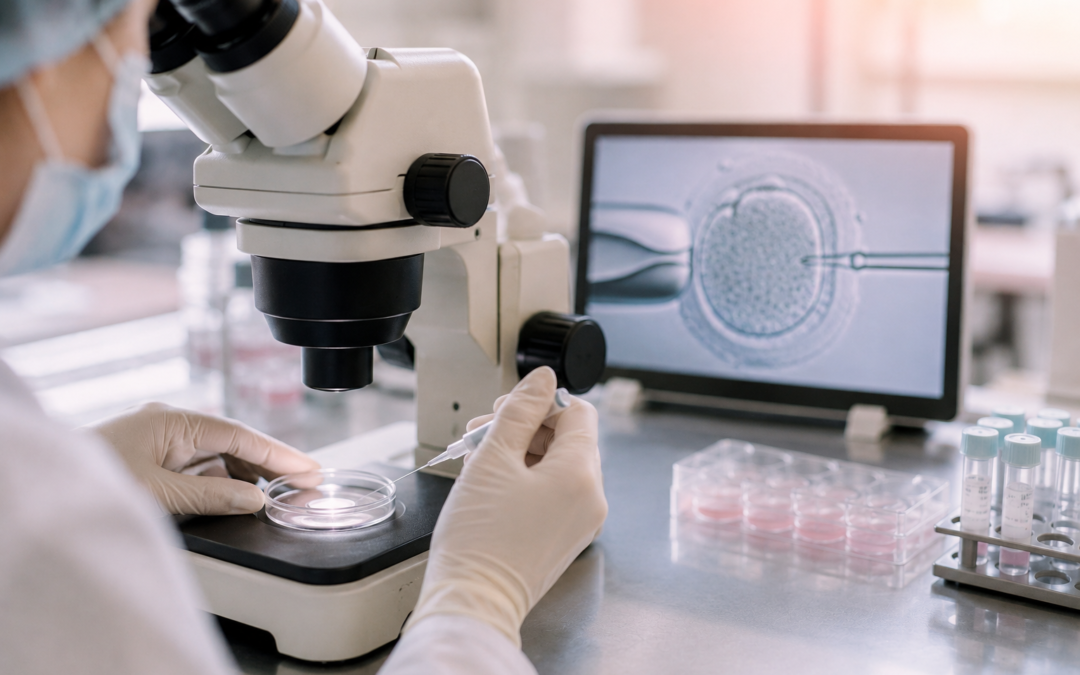
On July 25, 1978, Louise Brown became the world’s first baby born through in vitro fertilization (IVF), a moment that quietly changed the course of reproductive medicine forever. Nearly five decades later, World IVF Day offers an opportunity to reflect on how far science has come and to recognize the decades of research and perseverance that transformed IVF from a controversial experiment into one of the most significant medical advances of the modern era.
What began with a single birth in Oldham, England has grown into one of the most widely used forms of assisted reproductive technology in the world. In 2023 alone, nearly 9,000 babies were born through IVF in Canada, and more than 13 million babies have been born through IVF globally since 1978. At its core, the process involves retrieving mature eggs, fertilizing them in a laboratory, and transferring a resulting embryo into the uterus, but how much the science behind each of those steps has changed is remarkable.
The Early Days
The first IVF cycles were quite simple by today’s standards: just one egg retrieved from a natural cycle, with one opportunity for fertilization. Word spread fast, and clinics began opening around the world. Canada was among the first: the first Canadian clinic opened in Laval, Quebec in 1980, and by 1982 the clinic at the University of British Columbia had achieved the first IVF pregnancy and birth in the country.
Key Milestones in the Lab
Much of the most meaningful progress in IVF happened in the embryology lab, where scientists worked steadily to understand how to support human embryos developing outside the body. Some of the most significant advances include:
- Improved culture media: The nutrient solutions that support embryos between fertilization and transfer became increasingly refined over time, and by 1998, these improved formulas made it possible to sustain embryos all the way to the blastocyst stage, which contributed to improved implantation rates.
- Vitrification: This flash-freezing technique, which became the clinical standard starting in 2005, transformed frozen embryo transfers by minimizing the embryo damage caused by earlier slow-freezing methods, allowing patients to bank embryos for future use.
- Intracytoplasmic sperm injection (ICSI): Introduced in 1992, ICSI involves injecting a single sperm directly into an egg, making fertilization possible in cases where it may not occur on its own. This opened the door for many patients who previously had few options.
Genetic Testing Changes the Game
Preimplantation genetic testing has been one of the most discussed developments in modern IVF, changing what IVF can do for patients:
- PGT-A (preimplantation genetic testing for aneuploidy): First reported in 1993, PGT-A screens embryos for chromosomal abnormalities before transfer, which can help guide embryo selection for patients who have experienced recurrent pregnancy loss, repeated implantation failure, or multiple unsuccessful cycles.
- PGT-M (preimplantation genetic testing for monogenic conditions): First used successfully in 1990 to help a couple avoid passing on a hereditary condition, PGT-M now allows embryos to be screened for specific inherited conditions, including cystic fibrosis, sickle cell disease, and Huntington’s disease, offering families with known genetic conditions the possibility of reducing the risk of transmission to the next generation. The Fertility Friends Foundation supports those in need of PGT-M through the PGT-M Access Fund.
The AI and Technology Frontier
Embryo grading has traditionally relied on embryologists visually assessing embryos under a microscope. Time-lapse imaging, introduced to IVF labs in 2009, changed that by allowing embryologists to watch embryos develop continuously, without ever removing them from the incubator. More recently, AI tools have started to support this process too: since 2019, algorithms trained on large datasets of embryo images and outcomes have helped make embryo assessment more objective. The goal is not to replace the clinicians and embryologists who are central to this work, but to provide better tools to support decision-making.
What’s Next
The next chapter of IVF is still being written. Researchers are exploring in vitro gametogenesis, the possibility of creating eggs or sperm from other cell types like skin or blood cells, which could one day offer new pathways to parenthood for a broader range of people. Uterine receptivity testing is gaining traction too, looking at whether timing a transfer more precisely to each patient’s natural implantation window could help those who have faced repeated failure despite transferring healthy embryos. The thread running through all of it is personalization, getting away from standardized protocols and building treatment around the individual patient.
Conclusion
IVF has come a long way since the birth of Louise Brown in 1978. In Canada and around the world, more people than ever are building their families with its help, and science continues to evolve. World IVF Day is an opportunity to pause and recognize not only the advances in technology, but also the researchers who remained committed to solving complex challenges, the clinicians who continually refined their practice, and the patients who faced each cycle with hope and resilience. That combination is what got us here, and what will keep moving the field forward. If you or someone you know is navigating fertility treatment, the Fertility Friends Foundation is here to help.
References
- Steptoe PC, Edwards RG. Birth after the reimplantation of a human embryo. The Lancet. 1978;2(8085):366.
- Adamson GD, Creighton P, de Mouzon J, Zegers-Hochschild F, Dyer S, Chambers GM. How many infants have been born with the help of assisted reproductive technology? Fertility and Sterility. 2025;124(1):30-36. Available at: https://www.sciencedirect.com/science/article/abs/pii/S0015028225000858
- Canadian Fertility and Andrology Society (CFAS), BORN Ontario. Canadian Assisted Reproductive Technologies Register (CARTR Plus) Annual Report: 2024 Data. 2025. Available at: https://cfas.ca/_Library/CARTR/2025_CARTR_annual_report_CFAS_2024_Data_.pdf
- Yuzpe AA. A brief overview of the history of in vitro fertilization in Canada. Journal of Obstetrics and Gynaecology Canada. 2019. Available at: https://www.jogc.com/article/S1701-2163(19)30764-9/fulltext
- Bak CW, et al. The pioneering of intracytoplasmic sperm injection: historical perspectives. Reproduction. 2017;154(6). Available at: https://doi.org/10.1530/REP-17-0308
- Blockeel C, et al. An advanced SWOT analysis of elective vitrification: today’s standard IVF procedure. Human Reproduction. 2026. Available at: https://www.sciencedirect.com
- Doroftei B, et al. A mini-review regarding the clinical outcomes of IVF following PGT via next-generation sequencing. Diagnostics. 2022;12(8):1911. Available at: https://www.ncbi.nlm.nih.gov/pmc/articles/PMC9406843/
- Li M, et al. Advancements and applications of preimplantation genetic testing in IVF: a comprehensive review. PMC. 2024. Available at: https://www.ncbi.nlm.nih.gov/pmc/articles/PMC11061269/
- Borna MR, et al. An artificial intelligence algorithm to select most viable embryos considering current process in IVF labs. Frontiers in Artificial Intelligence. 2024. Available at: https://www.frontiersin.org
- Adashi EY, Wessel GM. In vitro gametogenesis in the ongoing quest to vanquish infertility: the role of epigenetics. F&S Reports. 2024. Available at: https://www.ncbi.nlm.nih.gov/pmc/articles/PMC11705579/
- Murase Y, et al. In vitro reconstitution of epigenetic reprogramming in the human germ line. Nature. 2024. doi:10.1038/s41586-024-07526-6
- Gardner DK, Vella P, Lane M, Wagley L, Schlenker T, Schoolcraft WB. Culture and transfer of human blastocysts increases implantation rates and reduces the need for multiple embryo transfers. Fertility and Sterility. 1998;69(1):84-88.
- Kuwayama M, Vajta G, Kato O, Leibo SP. Highly efficient vitrification method for cryopreservation of human oocytes. Reproductive BioMedicine Online. 2005;11(3):300-308.
- Munné S, Lee A, Rosenwaks Z, Grifo J, Cohen J. Diagnosis of major chromosome aneuploidies in human preimplantation embryos. Human Reproduction. 1993;8(12):2185-2191.
- Handyside AH, Kontogianni EH, Hardy K, Winston RM. Pregnancies from biopsied human preimplantation embryos sexed by Y-specific DNA amplification. Nature. 1990;344(6268):768-770.
- Khosravi P, Kazemi E, Zhan Q, et al. Deep learning enables robust assessment and selection of human blastocysts after in vitro fertilization. npj Digital Medicine. 2019;2:21.